

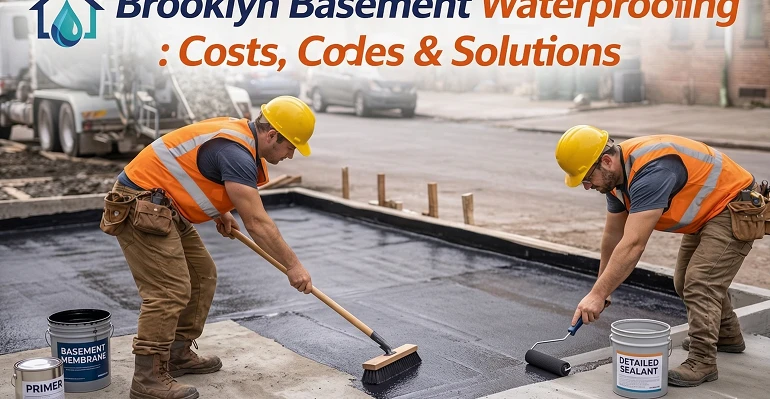
Protecting Your Brooklyn Home: The Ultimate Guide to Basement Waterproofing, Moisture Control, and DOB Compliance
If you own residential or commercial property in Brooklyn, you are likely intimately familiar with the profound anxiety that accompanies a severe weather forecast. In recent years, our borough has experienced an unprecedented and accelerating increase in extreme rainfall events. From the devastating remnants of Hurricane Ida that tragically cost eleven New Yorkers their lives in below-grade apartments, to the sudden flash floods that submerged parts of Sunset Park, Park Slope, and Clinton Hill in late 2025, the meteorological reality is undeniable. Brooklyn's century-old, combined sewer infrastructure simply cannot process the sheer volume of modern stormwater runoff.
When municipal catch basins inevitably back up and the local water table rapidly rises, groundwater seeks the path of least resistance. All too often, that path leads straight through the aging foundation walls of your home. Whether you are dealing with a perpetually damp, musty cellar in a historic Bedford-Stuyvesant brownstone, or you are recovering from standing water after heavy rain in a newly renovated space, basement waterproofing is no longer just an optional home improvement project—it is an absolute necessity for property defense and life safety.
In this comprehensive guide, we explore the highly unique architectural challenges of keeping a Brooklyn basement dry, the average financial investments involved, and how new NYC building codes—specifically Local Law 126—are radically changing the way homeowners must approach basement renovations and legalizations.
Why Brooklyn Homes Are Uniquely Vulnerable to Water Seepage
Water intrusion in New York City is rarely as simple as a singular leaky pipe. The hydrodynamics of our densely packed neighborhoods present highly specific challenges that require specialized foundation repair and leak sealing solutions.
1. The Brownstone and Pre-War Architecture Challenge Many of Brooklyn's iconic brownstones and pre-war brick townhouses were constructed over a century ago using raw stone or rubble cellars. Over decades of exposure to groundwater, the mortar in these porous foundations naturally degrades and dissolves. Furthermore, because attached townhouses share masonry party walls, water problems are frequently communal. A neighbor's plumbing leak, a faulty old radiator valve, or poor yard grading next door can easily result in hydrostatic pressure pushing moisture directly laterally through your shared masonry. This phenomenon causes peeling paint, widespread efflorescence (the white, chalky mineral powder left on walls as water evaporates), and eventual structural flooding.
2. The Single Downspout Dilemma Most attached homes in Brooklyn feature a single rear roof downspout that channels the entirety of the building's rainwater runoff into a highly constrained, enclosed backyard space. Without proper surface grading or a dedicated exterior drainage system connected to the municipal sewer, hundreds of gallons of water rapidly pool directly against the rear foundation wall during a storm, creating immense hydrostatic pressure that forces water through microscopic cracks in the concrete.
3. Zero-Lot-Line Restrictions and the Exterior Excavation Problem In suburban environments, the standard operational method for waterproofing a foundation involves bringing in heavy machinery to excavate the soil entirely around the exterior of the house, applying a waterproof membrane, and installing exterior French drains. In Brooklyn, homes are built directly up to the property line, often sharing walls. Excavating exterior walls is frequently physically impossible, legally prohibited by landmark status, or financially exorbitant due to limited manual access. Therefore, the most effective and reliable solutions rely on highly engineered, localized interior waterproofing systems.
The Most Effective Waterproofing Methods for NYC Properties
Because exterior excavation is rarely viable in our borough, modern basement waterproofing in Brooklyn NY focuses entirely on managing the water as it attempts to enter the structure, intercepting it, and safely channeling it back out into the municipal system.
Interior Drainage Systems (French Drains): This is the undisputed gold standard for urban attached homes. A shallow trench is carefully excavated along the internal perimeter of the basement floor. A specialized, clog-resistant drainage channel is installed directly on top of the foundation footing (at the critical cove joint where the wall meets the floor) and covered with fresh concrete. This system intercepts groundwater seepage before it ever breaches the basement floor.
High-Capacity Sump Pump Installation: The interior drainage system relies on gravity to direct intercepted water to a designated sump pit. High-capacity, cast-iron sump pumps actively pump the collected water out of the house and safely away from the foundation. Given the frequency of storm-related grid failures in New York, it is highly recommended to install a system equipped with a battery backup to ensure continuous protection during power outages.
High-Pressure Epoxy Crack Injection: For newer poured concrete foundations experiencing localized vertical or diagonal cracking, high-pressure epoxy or polyurethane foam injections can be utilized. The resin is injected deep into the fissure, expanding to permanently seal the crack from the inside out, restoring structural integrity and stopping active leaks instantly.
Wall Encapsulation and Vapor Barriers: Heavy-duty, anti-microbial liners are mechanically fastened to foundation walls to seal off incoming moisture and direct any wall condensation straight down into the perimeter drainage system. This is absolutely crucial for controlling indoor humidity, preventing hazardous black mold growth, and improving the overall air quality of the property.
How Much Does Basement Waterproofing Cost in Brooklyn?
Cost is understandably the primary point of friction for most homeowners considering structural repairs. The final financial investment required depends heavily on the total linear footage of the space, the severity of the existing hydrostatic pressure, and the specific methods deployed.
Due to the complexities of working in confined urban spaces, basement waterproofing in Brooklyn generally ranges from $4,000 to $12,000 for a comprehensive system.
Targeted, minor crack repairs and epoxy sealants typically fall between $250 and $1,800.
Installing a comprehensive interior perimeter French drain system generally costs between $1,500 and $6,000, depending on the length of the trench.
A reliable, professional-grade sump pump system installation runs between $1,000 and $3,200.
While this represents a significant capital investment, it is important to understand the insurance realities. Standard homeowners insurance policies rarely cover water damage resulting from chronic foundational groundwater seepage or poor home maintenance. Investing proactively in preventative waterproofing prevents the catastrophic, out-of-pocket costs associated with post-flood mold remediation, structural rot, and the devastating loss of personal property.
Legalizing Your Space: NYC Building Codes, ADUs, and Local Law 126
Beyond the immediate need for weather protection, there is a massive economic incentive driving the current demand for dry, secure basements: property valuation and legal rental income.
New York City makes a very strict legal and zoning distinction between a "basement" (defined as a space that is at least 50% above curb level) and a "cellar" (a space that is more than 50% below curb level). Historically, converting these sub-grade spaces into legal, income-producing apartments was a regulatory nightmare filled with red tape. However, the introduction of Local Law 126 of 2024 has created a landmark 10-year pilot program designed to help property owners safely and legally convert existing, informal basement and cellar apartments into approved residences.
If you are planning to convert your basement into a legal Accessory Dwelling Unit (ADU), the NYC Department of Buildings (DOB) mandates strict, uncompromising compliance with current building and energy codes.
Mandatory Dampproofing: According to the NYC Building Code (Article 27-2081), habitable spaces below grade must be comprehensively dampproofed and waterproofed to the height of the ground level. The space must be definitively free from dampness.
Energy Code Compliance: Any insulated basement walls are strictly required to have an interior vapor barrier installed to pass DOB inspections.
Egress and Ventilation: Furthermore, legal bedrooms must have egress windows that meet highly specific criteria: the bottom of the window can be no higher than 44 inches from the floor, the opening must provide at least 5.7 square feet of clearance, and total window space must equal at least 4% of the floor area for ventilation.
Attempting to finish a basement—putting up studs, drywall, and luxury vinyl flooring—without first installing a commercial-grade waterproofing system is a disastrous misstep. Failure to properly waterproof the space will not only result in instantly failed municipal DOB inspections but will trap unseen moisture directly within the newly built walls, leading to rapid structural rot, toxic mold proliferation, and the total destruction of your renovation investment. Professional basement waterproofing is the mandatory, non-negotiable first step before any remodeling or legalization project can legally or safely commence.
Secure Your Foundation and Your Investment Today
Whether you are seeking to protect your family's irreplaceable heirlooms from the next devastating flash flood, eliminate musty, unhealthy odors stemming from an aging brownstone crawl space, or prepare your property for a highly profitable, code-compliant ADU conversion under Local Law 126, professional intervention is required. Do not wait for the next major storm system to test the limits of your aging masonry foundation. Secure your home, improve your indoor air quality, and permanently safeguard your property's structural integrity with industry-leading, Brooklyn-tested basement waterproofing solutions.