

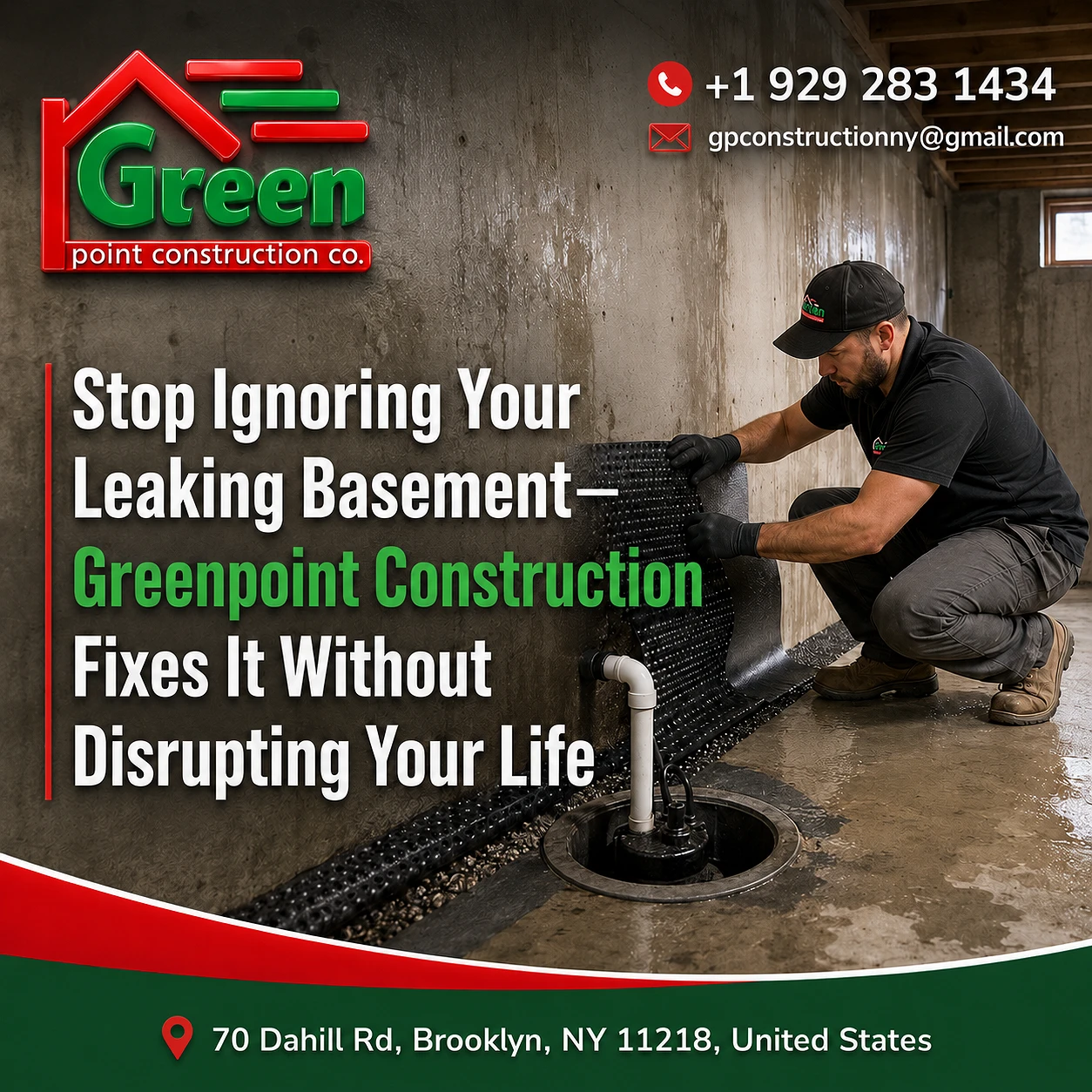
Stop Ignoring Your Leaking Basement—Greenpoint Construction Fixes It Without Disrupting Your Life
Stop Ignoring Your Leaking Basement—Greenpoint Construction Fixes It Without Disrupting Your Life
Your basement has been damp for a while now. Maybe it's just a little moisture on the walls. Maybe you've got actual pooling water in one corner. Either way, you've been avoiding thinking about it because the last thing you need right now is contractors living in your home for three months.
Here's the thing: basement waterproofing doesn't have to be the chaos you're imagining. But you do need to understand what's actually happening down there and why it matters.
Why Brooklyn Basements Leak
Brooklyn's buildings are old. Really old. We're talking foundation walls that have been fighting New York groundwater for 80, 90, sometimes 120 years. Add Brooklyn's clay-heavy soil—which holds water like a sponge—and you've got a perfect storm for wet basement problems.
Most homeowners think their basement leaks because something is "wrong" with their foundation. That's not quite right. Your foundation isn't failing. It's doing exactly what 1920s construction was designed to do: it's letting water through. Back then, people just accepted wet basements. They used them for storage and stayed out of them in spring.
You can't do that anymore. Water in your basement means mold risk, structural deterioration, and the kind of slow damage that gets exponentially more expensive the longer you ignore it.
The reality is that Brooklyn's foundation challenges are specific. The clay soil retains moisture. The water table rises seasonally. Old mortar joints deteriorate. Your basement didn't suddenly develop a problem—it's been fighting water the entire time it's been standing.
Understanding Hydrostatic Pressure vs Moisture Problems
This is important: not all wet basements are the same, and treating them the same way is why most DIY solutions fail.
Hydrostatic pressure is water pushing against your foundation walls from outside. This happens when soil around your basement is saturated—usually from heavy rain, poor drainage around your property, or a high water table. You'll see water seeping through cracks in the walls, or sometimes appearing through the floor itself. This is the most common Brooklyn basement problem.
When you have hydrostatic pressure, the water is literally being forced through your foundation. No amount of interior cleanup stops it. The water keeps coming.
Moisture and condensation is different. This is humidity that condenses on your walls and floor, creating dampness and mold risk without actual pooling water. It's less dramatic but equally problematic because it creates mold, makes your basement smell, and makes the space completely unusable.
Most basements in Brooklyn actually have both problems. The outside water gets in (hydrostatic), and then humidity makes the whole space damp and uncomfortable. You might see water one week and just smell mustiness the next.
This matters because the solution depends on which problem you actually have. A contractor who doesn't understand the difference will probably throw expensive solutions at you that don't actually solve your real issue. You need someone who diagnoses before they prescribe.
Why Quick Fixes Fail Every Time
You've probably tried things. Drying it out. Running a dehumidifier. Patching cracks. Painting the walls with waterproof paint.
None of that stops water from coming in. It just slows it down temporarily.
Here's why: water always finds the path of least resistance. You patch one crack, and water finds another. You paint the walls, and water seeps through the floor. You run a dehumidifier, and it fills up every three days. You're stuck in a cycle of temporary solutions.
The problem is that you're treating symptoms, not the actual issue. The actual problem is that water is reaching your foundation in the first place.
Real basement waterproofing stops water before it gets there—or captures it and moves it away if it does. That requires understanding your lot, your drainage, your foundation conditions, and your building's specific situation. It's not generic. It's custom to your home.
That's why the guy who sold you "waterproof paint" at the hardware store couldn't solve this. That's why your dehumidifier is running 24/7 and still not keeping up.
What Real Basement Waterproofing Actually Involves
There's no single waterproofing solution that works for every basement. But here's what a real, lasting solution involves.
Exterior waterproofing is the most effective approach. This means digging around your foundation, exposing the basement walls, sealing cracks in the foundation, applying a waterproof membrane, and installing proper drainage around the perimeter. Water that does seep through the foundation gets directed to a drainage system and away from your home.
Exterior waterproofing is sometimes called "permanent" waterproofing because it solves the problem at the source—before water even touches your foundation. If you have yard space and your lot allows it, this is usually the best long-term investment.
Interior waterproofing works when exterior isn't possible. Maybe you're in a townhouse with no yard. Maybe you don't want to disrupt your landscaping. Interior solutions include sump pump systems that collect water inside your basement and pump it away, vapor barriers that prevent moisture from rising through the floor, and dehumidification systems.
Interior waterproofing isn't a compromise—it's a different approach. When done right, interior systems work well. But they're less disruptive to your property and your daily life, which matters if you're busy.
Most Brooklyn basements need both approaches. Some exterior work to manage water flow around the foundation, plus interior solutions to handle what still gets through. This combination approach works because it addresses the problem from both sides.
The key is that a real solution addresses the source of water, not just manages the result.
Real Timelines for Brooklyn Basement Waterproofing
Here's what nobody tells you: contractor timelines are almost always wrong because contractors don't want to scare you with accuracy.
Exterior waterproofing takes real time. We're talking 2-4 weeks for an average Brooklyn basement, depending on foundation size, the extent of the work, and whether we find surprises (old mortar joints, foundation damage, hidden damage we couldn't see until we started digging). That's honest time. Not "3-5 days" time that turns into six weeks.
Interior-only basement waterproofing is faster—usually 3-7 days for a complete system install. You're not digging. You're not exposing foundation. You're just setting up interior drainage and sump systems.
The difference is important. If a contractor gives you a vague timeline like "about two weeks," they're avoiding accountability. A real timeline breaks down the work phase by phase so you know exactly what to expect.
When you're a busy professional, accuracy matters. You need to know if you're talking about a week-long disruption or a month-long one. That changes how you manage your calendar and your life.
Managing Disruption When You're Already Busy
You're a professional. Your schedule doesn't flex. The thought of contractors in your home disrupting everything is partly why you've been putting this off.
Real talk: waterproofing does involve some disruption. If we're doing exterior work, we need access to your lot, and there will be excavation noise. If we're doing interior work, we're in your basement, and there will be drilling and work happening during daylight hours.
But here's what you don't need: contractors who extend the job, who show up at random times, who leave dust everywhere, who disappear for weeks then suddenly show up with surprise invoices.
A contractor who structures the work properly, schedules efficiently, and cleans as they go makes the whole thing manageable. Your life doesn't grind to a halt. You just know that Tuesday through Thursday, there's work happening, and then it's done.
The difference between good contractors and bad ones isn't whether the work is disruptive—it's whether the contractor respects your time enough to minimize that disruption and stick to a schedule.
Common Mistakes Homeowners Make with Basement Waterproofing
Don't hire based solely on price. Basement waterproofing is one of those projects where cheap usually means you'll be doing it again in five years. Real waterproofing costs what it costs. Low bids usually mean corners are being cut—maybe cheaper sump systems, maybe skipped exterior work, maybe materials that won't last.
Don't accept vague timelines. "3-5 weeks" is not a timeline. "Monday through Friday of next week, plus potentially one day the following Monday" is a timeline. If a contractor won't pin down specifics, they don't have a plan. They're guessing.
Don't skip the inspection. A contractor who doesn't thoroughly inspect your basement before giving you a price is not actually diagnosing your problem. They're just doing generic waterproofing. Your basement is unique. Your solution should be too.
Don't DIY this. Waterproofing requires understanding water flow, soil conditions, foundation structure, and proper drainage installation. YouTube will make it look simple. Then you'll spend $3,000 on equipment that doesn't solve the problem, and you'll still need to call a professional.
Don't wait for it to get worse. Water damage compounds. What costs $8,000 to fix now could cost $25,000 when the foundation starts cracking or mold becomes a health issue. The longer you wait, the more expensive it becomes.
What Waterproofing Actually Costs
This is the conversation nobody wants to have, but you need real numbers.
Basic interior waterproofing (sump pump and drainage system) typically runs $3,000-$8,000 depending on your basement size and how much water you're dealing with.
Exterior waterproofing is more expensive because it involves more labor and materials. You're looking at $8,000-$20,000+ depending on your foundation, lot size, and whether excavation reveals additional damage.
Combination approaches (exterior plus interior) run $12,000-$30,000.
Here's the thing: these aren't random numbers. They're based on the amount of work, materials, and time required to actually solve your problem. A quote significantly lower than this range means something is being skipped.
The cost is real, but so is the alternative: years of water damage, mold risk, decreased home value, and the stress of knowing your basement is wet.
The Real Cost of Waiting
Every year you leave your basement wet is another year of potential mold growth, structural deterioration, and decreased home value. Water damage compounds. What costs $8,000 to fix now could cost $25,000 when the foundation starts cracking or mold becomes a health issue.
Plus, you're living with the stress of knowing it's there. The smell. The worry. The knowledge that you're ignoring a problem. That's not free either.
When you actually do get around to waterproofing, the baseline cost is going to be higher because more damage will have occurred. You're essentially paying interest on a problem you could solve today.
Getting Started with Basement Waterproofing
If your basement is wet, you need a real inspection from someone who understands Brooklyn's specific challenges—clay soil, old construction, high water tables, and tight lots.
Greenpoint Construction has been waterproofing Brooklyn basements for 15 years. We'll look at your specific situation, tell you exactly what's happening, explain your options, and give you a real timeline. Then you can decide.
No pressure. No upsell. Just honest assessment and clarity about what needs fixing.
A free inspection should tell you:
- Whether you have hydrostatic pressure, moisture issues, or both
- Whether exterior, interior, or combination waterproofing makes sense for your home
- Realistic timeline for the work
- Realistic cost range
- What happens if you wait vs. what happens if you start now
Your basement doesn't need to be wet. And fixing it doesn't need to destroy your life.
Next Steps
The first step is getting a professional inspection. Not a sales pitch. Not someone trying to upsell you on features you don't need. Just an honest evaluation of what your basement actually needs.
Greenpoint Construction offers free basement inspections for Brooklyn homeowners. We show up on time, we explain what we find, we give you options, and we let you decide.
That's it. No obligation. Just clarity.
Greenpoint Construction specializes in basement waterproofing for Brooklyn and NYC homeowners. 25+ years of experience, licensed and bonded. We work around your schedule and deliver results that last.