

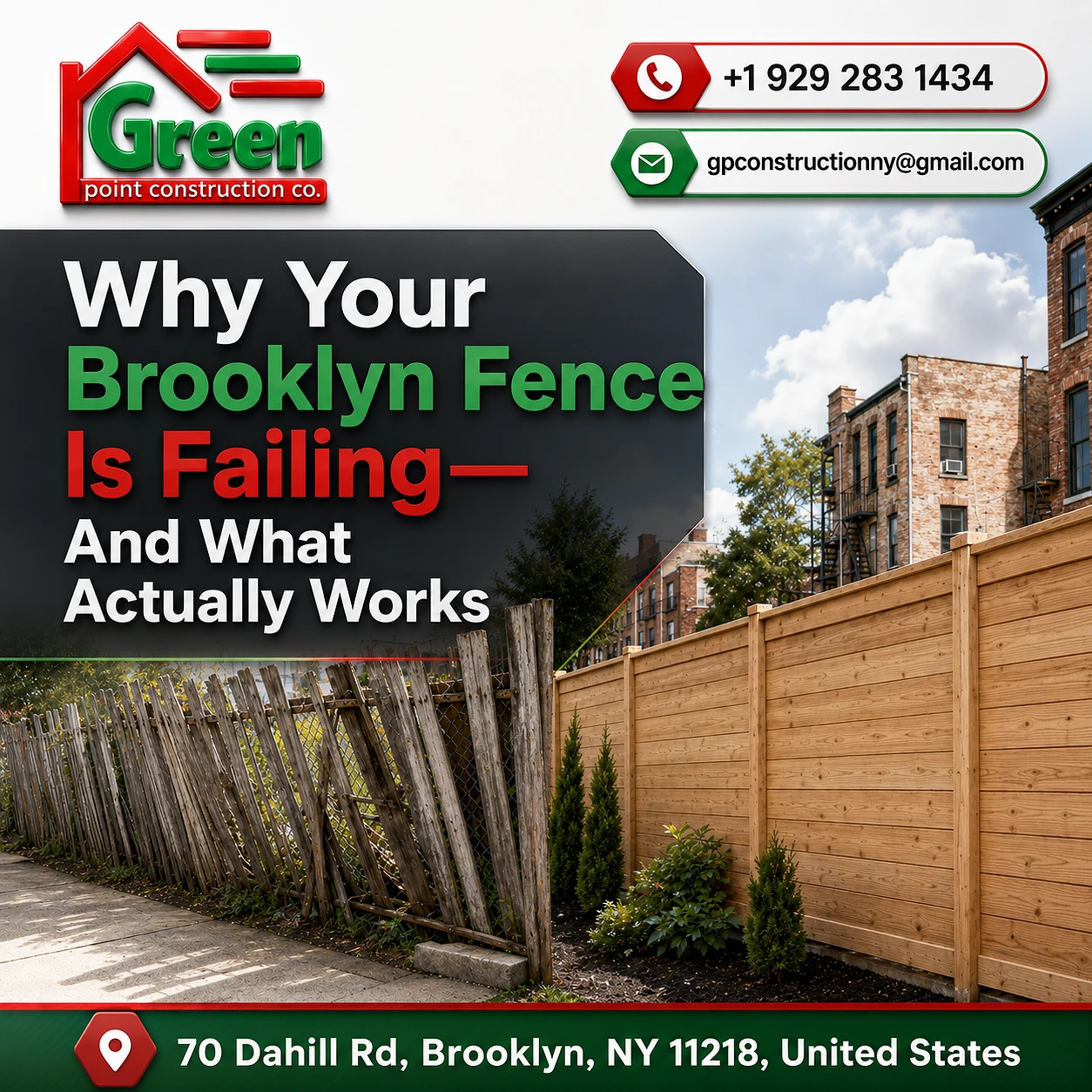
Why Your Brooklyn Fence Is Failing—And What Actually Works
You notice the gate doesn't close quite right. A few months later, one of the posts has a noticeable lean. By the following winter, you're seeing gaps between boards, and you're wondering if the whole thing is about to collapse.
Sound familiar?
You're not alone. We get calls from Brooklyn homeowners every week with the same story: a fence installed a few years ago that's already falling apart. They're frustrated. They're asking themselves if they got scammed. And they're wondering why a fence can't just last like it's supposed to.
The answer is simpler than you think—and it comes down to how the fence was actually built.
The Real Problem: Fences Built for Day One, Not for Brooklyn Winters
Here's what most contractors don't tell you about fence installation:
The difference between a fence that lasts 15 years and one that fails in 3 isn't expensive materials or fancy design. It's engineering.
Brooklyn's climate is brutal on fences. We get freeze-thaw cycles that push posts out of the ground. Salt air corrodes materials quickly. Wet springs mean moisture damage. Heavy snow loads stress poorly installed structures.
Most contractors know this. They just don't build for it.
Where Corners Get Cut
Shallow Post Holes: A contractor shows up, digs post holes, maybe 18 inches deep, and sets the posts. Looks fine on day one. Then winter comes. Frost heave—the natural expansion of freezing soil—pushes those posts up and out of line. By spring, they're leaning.
The fix? Posts need to be set 3-4 feet deep, below the frost line. That's labor. That costs time. So a lot of contractors don't do it.
No Concrete Footings: Even posts set to the right depth need something to anchor them. Concrete footings prevent settling and shifting. Without them, posts gradually move and sink. Your vertical fence becomes a leaning fence.
Wrong Materials: Not all wood is created equal. Pressure-treated lumber rated for ground contact lasts. Cheap wood that's just treated with a surface coat fails. The contractor saves money. You pay the price three years later.
Rushed Installation: A good fence job takes time. Posts need to be checked for level and plumb. Boards need to be measured and cut accurately. Gates need proper hinges installed correctly. When a contractor rushes through to move to the next job, every shortcut shows up later.
Why This Actually Matters—Beyond Just Aesthetics
A failing fence isn't just an eyesore. It's a problem that gets worse every season.
It becomes a liability. A fence that's falling toward your neighbor's property? That's a lawsuit waiting to happen.
Repair costs balloon. A small fix today becomes a full replacement tomorrow. You're throwing money at temporary solutions instead of investing in something that lasts.
Your yard feels chaotic. A fence is supposed to create a defined, secure space. When it's failing, it looks neglected. It affects how you feel about your own home.
Structural damage spreads. A leaning fence stresses the entire structure. Posts rot faster when they're not properly sealed. Wood splits and warps. What started as one problem becomes ten problems.
The Solution: Build It Right From the Start
So what actually works? Let's walk through how a fence should be installed—and why most contractors don't do it.
Proper Site Assessment
Before any digging happens, someone needs to actually understand your property.
What's the soil condition? Is it clay, sand, or rocky? That affects how deep posts need to be and what kind of footings work best.
Where are the utilities? Water lines, gas, electrical—they're all underground. Hitting one isn't just expensive; it's dangerous. A good contractor locates utilities before digging a single hole.
What's your actual property line? Fence disputes with neighbors happen because people guess at where the line is. Get it right from the start.
What are you trying to accomplish? Privacy, security, aesthetics, containing pets—different goals require different approaches.
This takes time. Most contractors skip it. That's mistake number one.
Proper Post Installation
Posts are the skeleton of your fence. If they're wrong, everything fails.
Posts need to be set below the frost line—typically 3-4 feet deep in Brooklyn. That concrete footing needs to extend below the post itself, creating a stable anchor that won't settle or shift.
The posts need to be checked constantly for plumb (perfectly vertical). A post that's off by even a quarter-inch will look worse over time and stress the entire structure.
Quality Materials Rated for Climate
Pressure-treated lumber rated for ground contact holds up. Vinyl fencing designed for coastal climates resists salt air. Metal gates need hinges that won't rust in salt spray.
Cheap materials save money upfront. They cost money every year afterward when they fail.
Attention to Details
Gate hinges installed correctly stay functional for years. Installed sloppily, they're loose and broken within a year.
Boards that are measured, cut, and installed properly don't cup, split, or warp. Boards installed by someone rushing show damage within seasons.
Drainage and airflow matter. Fences that trap moisture rot faster.
How Greenpoint Construction Approaches Fence Installation
We've been doing this for 15 years. We've installed thousands of feet of fencing across Brooklyn. Here's how we approach every job:
Step 1: Real Assessment
We visit your property. We listen to what you want and what concerns you. We check soil conditions, locate utilities, identify the actual property line, and give you honest advice about what works and what doesn't.
We don't show up with a one-size-fits-all approach. Your fence gets engineered for your specific situation.
Step 2: Clear Plan
You get a detailed timeline, transparent pricing, and a breakdown of exactly what's involved. No surprises. No hidden costs. You know what you're paying for and when the work will be done.
Step 3: Professional Installation
Posts are set to proper depth with concrete footings that won't shift with frost. Every board is measured, aligned, and installed correctly. Every gate hinge is installed to function smoothly for years. We check alignment constantly. We don't rush.
This takes longer than cutting corners. That's the point.
Step 4: Accountability
When we finish, we walk the fence with you. We explain maintenance steps to extend its life. We give you our number for questions. If something fails, we fix it.
We're licensed, bonded, and insured. But more importantly, we're the contractors you call back because what we built actually works.
Real Example: The Williamsburg Townhouse
We installed a privacy fence for a townhouse owner in Williamsburg last year. She'd gotten quotes from three other contractors. All of them quoted low prices and quick turnarounds.
We walked the property, explained that the soil conditions required deeper posts, showed her why salt air corrosion would be a problem with cheap materials, and gave her a higher quote for a fence built to last.
She chose us.
Two months later, the fence was done. Properly set posts, quality materials, professional installation. Will it last? Absolutely. Will she be calling us for repairs in three years? No. She'll be forgetting about it because it works.
That's the difference.
What to Watch For When Hiring a Fence Contractor
Before you hire anyone, ask these questions:
"How deep are you setting the posts?" Listen for specific numbers tied to soil conditions and frost line depth. If they say "standard depth," that's a red flag.
"What kind of concrete footings are you using?" They should explain how footings prevent settling and frost heave.
"Will you locate utilities before digging?" If they hesitate, move on.
"What's your timeline, and why does it take that long?" Good work takes time. If they promise to finish in two days, they're cutting corners.
"Are you licensed and insured?" Non-negotiable. Get references.
"What happens if something fails?" They should stand behind their work.
Your Next Step
If your fence is failing, leaning, or you're just done with what's there, you have options. You can hire the cheapest contractor and hope for the best. Or you can invest in something built to actually last.
Greenpoint Construction has been installing fences in Brooklyn for 15 years. We know what works in this climate. We engineer every fence to survive. We don't disappear after installation.
Get a free assessment. We'll walk your property, explain what's needed, and give you an honest price. No obligation. No sales pitch.
Your fence doesn't have to be a constant problem. Let's build one that works.
📞 CONTACT GREENPOINT CONSTRUCTION
Phone: +1 929 283 1434
Text: +1 929 283 1434 (faster response)
Email:gpconstructionny@gmail.com
Address: 70 Dahill Rd, Brooklyn, NY 11218
Website: greenpointconstructionny.com
Schedule your free fence assessment today.
#BrooklynFencing #FenceInstallation #BrooklynContractors #LocalBusiness #HomeImprovement #Craftsmanship